Copenhagen, 30 September – 1 October 2026. What does it take to turn plant-based ambitions into real food on real plates? To find out, a delegation of 16 Spanish stakeholders spent two days in Denmark, meeting the politicians, farmers, officials, and retailers driving one of Europe’s most ambitious plant-based food transitions.
The visit was organised by the Embassy of Denmark in Spain and the Vegetarian Society of Denmark.
The delegation included representatives from Spain’s regional governments, including the Autonomous Governments of Catalonia, Aragón, Valenciana, Castilla-La Mancha, as well as the Spanish Senate’s Agriculture Committee, the agricultural association ASAJA, and the retail association ASEDAS.
The visit will be followed up later this year, where the Embassy of Denmark in Spain will gather the stakeholders again for a talk on how to translate the Danish initiative to the Spanish context.
First, the delegation paid a visit to where it all started, Folketinget, the Danish Parliament. Carl Valentin, Member of Parliament for the Socialist People’s Party, walked the delegation through the broad political agreement that first created a dedicated fund for the plant-based transition – The Plant-Based Food Grant – and then set a cross-ministerial National Action Plan for Plant-Based Foods in motion.
“Perhaps the most interesting thing about Denmark is how pragmatically it is approaching this transition, focusing on how to move from policy goals to actual production, commercialization and consumption,” says Almudena Vázquez Mansilla, Agrifood & Circular Economy Advisor at the Embassy of Denmark in Spain.
Next came a question many in the room were eager to ask: “What’s in it for the farmers?” This question was tackled at the following meeting with Anders Klöcker, Head of Innovation at the Danish Agriculture & Food Council, who explained why the Danish farming sector has chosen to back the plant-based agenda rather than resist it:
“We want to be part of any opportunities that can secure a prosperous future for our farmers. We don’t want to close any doors. We want to open them. However, we will continue working diligently, also for the development of a greener and more efficient animal production since this is where the vast majority of consumers are at the moment”, Anders Klöcker stated.
Hereafter, the delegation received insights from the ministerial machinery. Mia Stecher from the Ministry of Nature and Welfare and Mads Fischer-Møller from the Ministry for Business and Competitiveness took the delegation behind the scenes. They told how the government brings key stakeholders to the table and what it takes to draft a national action plan.
Supermarkets shape what we eat every day. It was therefore natural that the delegation also met with Nina la Cour, consultant at Lidl, who explained why Lidl joined the Legume Partnership and how retailers can help drive change across the food system. According to Lidl Denmark, retailers have a responsibility to lead the way towards healthier options. This includes actively engaging in campaigns that promote legumes and making beans and legumes more visible and accessible to consumers in stores.
The first day concluded with a meeting with Marie Louise Boisen-Lendal, Director of the think tank Frej, who shared the Danish recipe for broad political support and gave the delegation a closer look at the Danish Plant-Based Food Grant and the projects it funds. For Boisen-Lendal the take home message was that cooperation and dialogue across sectors and NGO communities have been the key to success in Denmark.
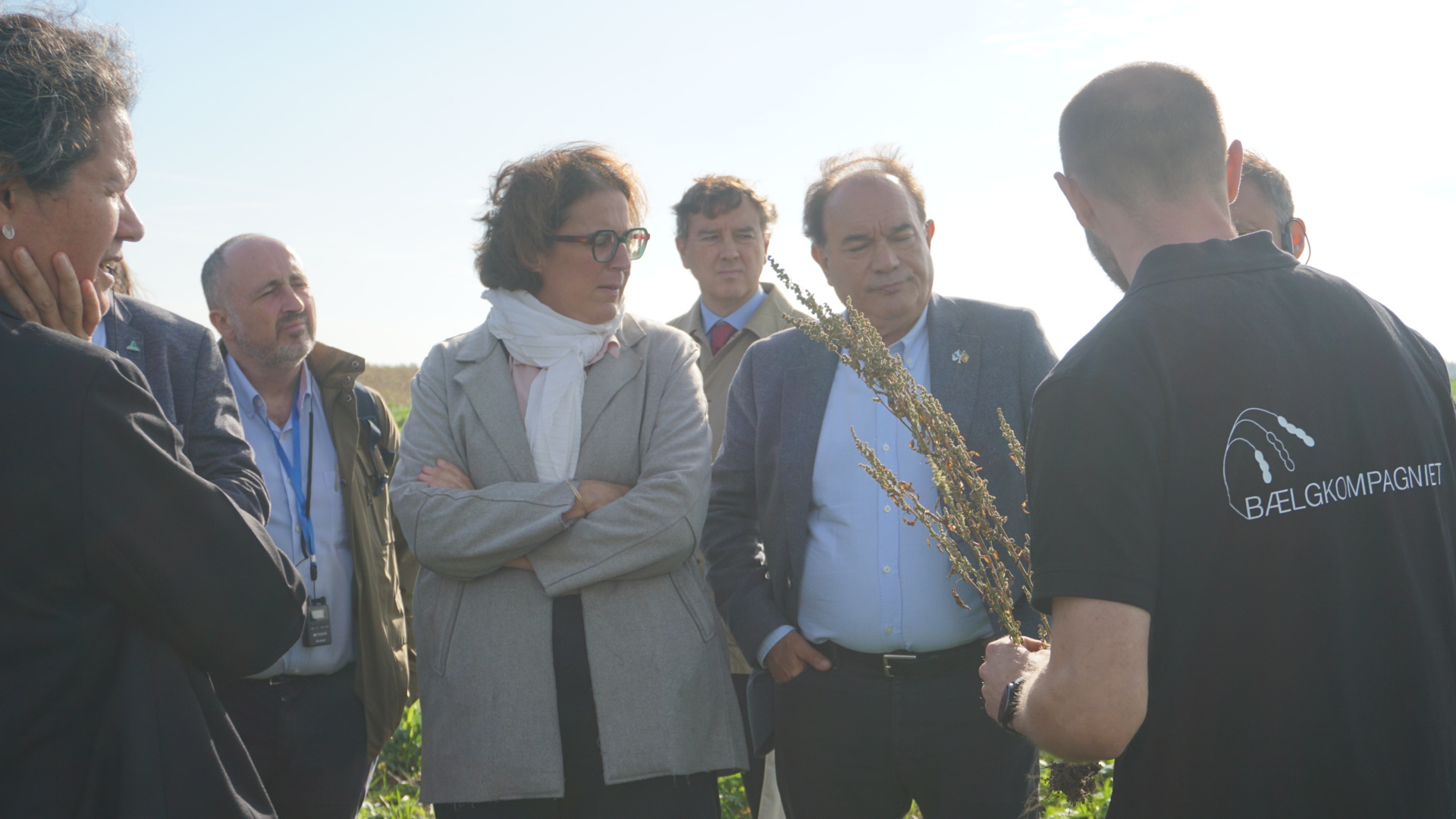
The following day the delegation had to wake up early for a long drive to where the visit ended where the transition comes alive: on the farm. At Bælgkompagniet, a family-owned business that grows and processes Danish organic legumes, the delegation heard first-hand why the family traded pig farming for organic legumes, and what that leap has meant for them.