Berlin, 5th of May 2026. Retailers, organic and conventional farmers organizations, experts, NGOs and industry stakeholders gathered for a productive discussion on the benefits of a more organic and plant-based food system in Germany, and how actors across the food system can work together to gain greater traction and impact. Across production, retail shelves, and policy.
The backdrop was the new German climate protection program 2026, where it’s stated that the Federal Government will strengthening domestic protein crop cultivation, and will support the development and market introduction of sustainable alternative proteins.
Shared values creates oppertunities
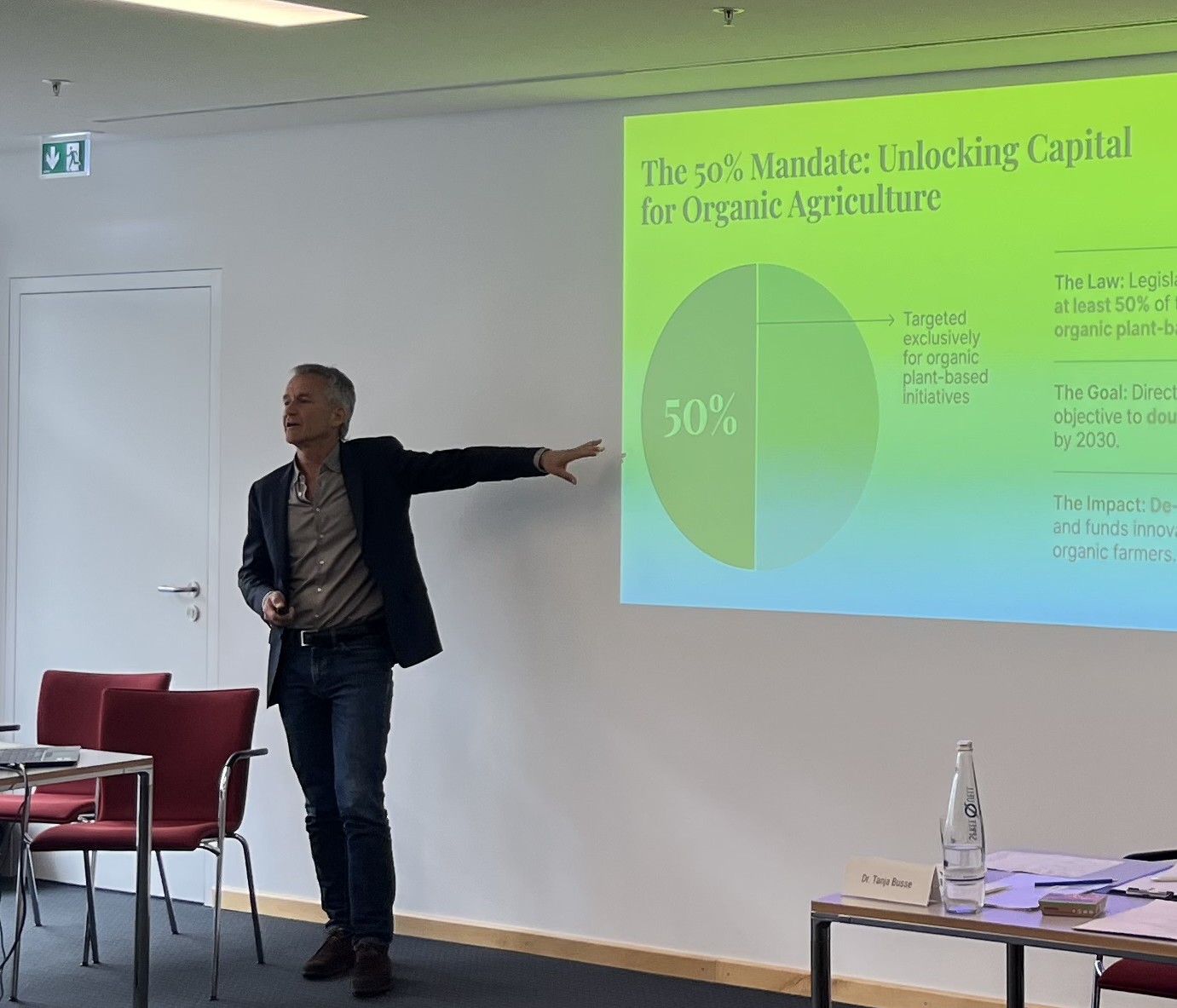
Paul Holmbeck, lifelong organic advocate, former director of Organic Denmark and World Board Member in IFOAM, delivered a keynote speech, emphasizing that achieving healthy and sustainable food systems while protecting biodiversity and groundwater requires stronger collaboration between the organic and plant-based sectors.
He highlighted that across Europe and the United States, consumers show a strong preference for plant-based products that are organic, representing significant market potential and a clear incentive for collaboration, while also enabling retailers and processors to increase both consumer value and ESG impact.
The €170 million Danish Plant-Based Food Grant was also highlighted as a key policy success supporting plant-based and organic projects in Denmark, aiming to stimulate both demand and supply.
According to Paul Holmbeck there is a big overlap of shared values between the plant-based and organic movements, making the perfect opportunity for cooperation in both policy and market development.
Substantial room for growth
Simon Handschuh, Policy Advisor for Germany at ProVeg International, presented findings showing that Germany is the largest market for plant-based alternatives in Europe. Notably, a growing share of these products is produced organically, including 66% of plant-based milk and 24% of plant-based meat. Compared to other European countries, this represents a massive market share; for instance, Spain’s organic market share sits at roughly 16% for plant-based milk and 5% for meat alternatives.
This data suggests there is still substantial room for growth in organic plant-based market shares for the plant-based category.
The following discussions focused on how organic and plant-based stakeholders can better collaborate to achieve policy wins and drive increased consumer demand and sales.
The German Federal Government estimates that supporting alternative proteins and plant-based diets could reduce emissions by 8.48 million tons of CO₂-equivalent by 2040. Equivalent to taking about 1.8 million passenger cars off the road for a year.
But despite the great potential, the pathway to achieving this goal remains unclear. And largely unfunded. Showing that food system stakeholders need to collaborate and show common solutions to operationalize the high political ambitions.
Participants agreed on the importance of sustaining this dialogue and identifying further synergies between the organic and alternative protein sectors. The insights from this session are currently being summarized into a working paper to help inform those ongoing efforts. As part of a larger project series focused on alternative proteins and sustainability, the findings from all sessions will ultimately be compiled into a final report and presented at a closing conference in March 2027.
The event: Fachgespräch zu alternativen Proteinen und ökologischer Land- und Lebensmittelwirtschaft, was organized by ProVeg International and GFI Europe.
Participation in the event of the Danish speaker is part of an EU project, which has received grants from the Green Development and Demonstration Programme (GUDP) under the Ministry of Food, Agriculture, and Fisheries of Denmark.