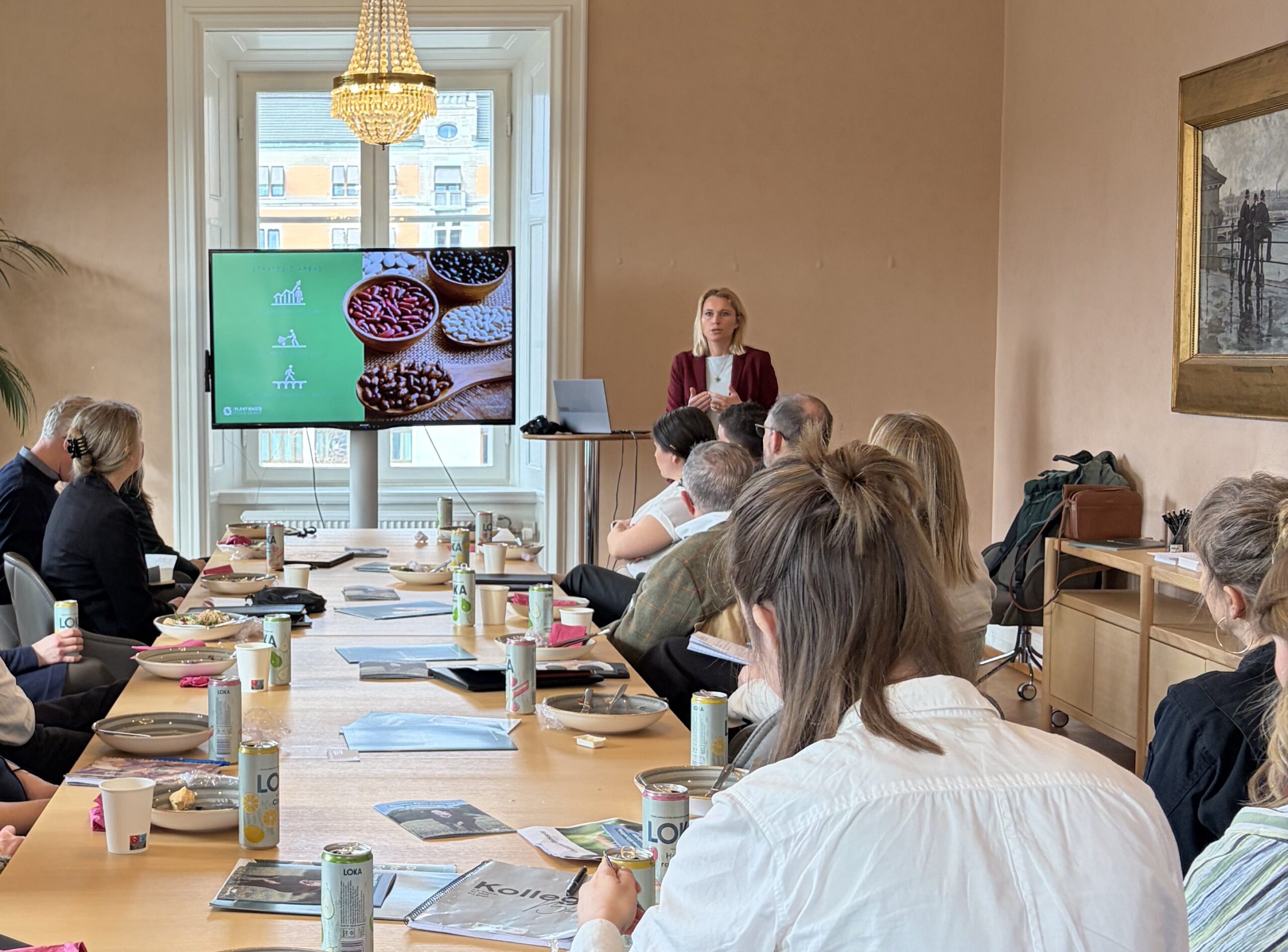
Stockholm, 18th of March 2026. Members of the Swedish Parliament and key Swedish stakeholders gathered at a seminar in the Swedish Riksdag to gain insights into how Danish plant-based policies and funding mechanisms are stimulating the demand and supply of plant-based foods and strengthening plant-based value chains in the Danish food sector.
The Swedish government launched a Food Strategy 2.0 in October 2025, a strategy that, among other things, aims to increase self-sufficiency of green proteins in Sweden.
The event aimed to explore what Sweden could learn from the Danish approach towards strengthening the production and consumption of fruits, greens, legumes, and other plant-based foods.
Marie-Louise Boisen Lendal, chair of the Danish Plant-Based Food Grant, gave concrete examples of tools that develop plant-based value chains. One was the importance of public financing to evolve and strengthen the plant-based sector, like the Danish Plant-Based Food Grant.
The other was to acknowledge the growth potential in the sector and to see plant-based production as a possibility to grow and diversify agriculture.
Also presenting was Amanda Wood, researcher at the Swedish University of Agricultural Science. Her intervention gave a comprehensive overview of what drives a shift to more healthy diets. Effective measures were comprehensive policy packages that address many things simultaneously, in combination with policy coherence, meaning that the majority of policies must pull in the same direction, with the aim of increasing the uptake of a healthy diet.
The event was hosted by Rebecka Le Moine from The Green Party and Sebastian Wiklund from the Swedish NGO Djurens Rätt.
——————————————–
Participation in the event of the Danish speaker is part of an EU project, which has received grants from the Green Development and Demonstration Programme (GUDP) under the Ministry of Food, Agriculture, and Fisheries of Denmark.